Companion planting for gardens: Creating a thriving vegetable garden isn’t just about tending to your edible plants—it’s about fostering an entire ecosystem that works together. Smart gardeners know that certain plants can serve as natural guardians, either by attracting beneficial insects that prey on garden pests or by actively repelling unwanted visitors through their scent or chemical properties. By strategically incorporating these helpful plants throughout your vegetable beds, you can reduce pest problems naturally, decrease your reliance on chemical interventions, and create a more balanced garden environment that practically takes care of itself. Let’s explore four powerful plant allies that can transform your vegetable garden’s health and productivity.
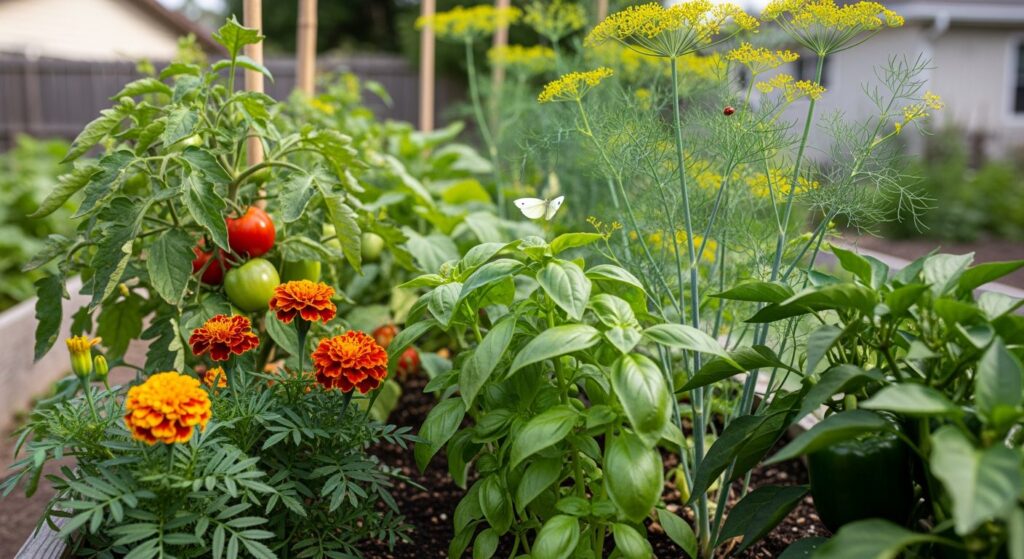
Marigolds: The Versatile Pest Deterrents for Companion Planting
Marigolds stand as perhaps the most celebrated companion plants for vegetable gardens, earning their reputation through multiple pest-fighting mechanisms. These bright flowers release a compound called alpha-terthienyl from their roots, which effectively repels nematodes—microscopic worms that damage plant roots and reduce yields. Beyond underground protection, marigolds’ strong scent confuses and deters many above-ground pests including aphids, whiteflies, and cabbage moths. For maximum effectiveness, plant French marigolds (Tagetes patula) or Mexican marigolds (Tagetes minuta) around the perimeter of your garden and between vulnerable crops like tomatoes, peppers, and cabbage family plants.

Nasturtiums: The Sacrificial Decoys in Companion Planting Systems
Nasturtiums employ a fascinating strategy in the garden ecosystem by functioning as trap crops—plants that attract pests away from your valuable vegetables. These colorful, easy-growing flowers are particularly irresistible to aphids, which strongly prefer nasturtiums over most garden vegetables. By planting nasturtiums near aphid-vulnerable crops like beans, cucumbers, and tomatoes, you essentially create a decoy that concentrates pest activity where it causes minimal damage. Additionally, nasturtiums attract beneficial insects including hoverflies and parasitic wasps, whose larvae devour aphids and other soft-bodied pests. Their sprawling growth habit makes them perfect for ground cover beneath taller vegetables.

| Plant | Pests Repelled | Beneficial Insects Attracted | Best Companion Vegetables | Planting Location |
|---|---|---|---|---|
| Marigolds | Nematodes, aphids, whiteflies | Ladybugs, parasitic wasps | Tomatoes, peppers, cabbage | Borders, between rows |
| Nasturtiums | None (acts as trap crop) | Hoverflies, parasitic wasps | Cucumbers, beans, squash | Garden edges, under trellises |
| Borage | Tomato hornworms, cabbage worms | Bees, predatory wasps | Tomatoes, strawberries, squash | Scattered throughout garden |
| Basil | Mosquitoes, flies, asparagus beetles | Bees, butterflies | Tomatoes, peppers, asparagus | Between vegetable plants |
Borage: The Bee Magnet for Enhanced Companion Planting Results
Borage deserves a special place in every vegetable garden for its remarkable ability to attract pollinators and beneficial insects. This herb produces abundant star-shaped blue flowers that bees find irresistible, helping to increase pollination rates throughout your garden. Beyond attracting pollinators, borage draws in predatory wasps that hunt caterpillars and other leaf-eating pests. The plant also contains compounds that strengthen disease resistance in neighboring plants, particularly strawberries and tomatoes. Borage’s deep taproot brings up nutrients from lower soil layers, effectively mining minerals that benefit surrounding plants when its leaves decompose. Plant borage near squash, tomatoes, and strawberries for maximum symbiotic benefits.
Basil: The Aromatic Defender in Vegetable Garden Companion Planting
Basil’s intense aromatic oils make it a powerful ally in pest management throughout the vegetable garden. These compounds effectively mask the scent of valuable crops, confusing pests that locate their preferred hosts through smell. Tomato hornworms, asparagus beetles, and various flies find basil’s strong scent particularly repellent. Beyond pest deterrence, basil appears to improve the flavor and growth of tomatoes when planted nearby—a classic companion planting relationship backed by generations of gardeners. For best results, interplant basil throughout your garden rather than isolating it in one area. This herb thrives in the following locations:
- Between tomato plants to deter hornworms and enhance flavor
- Near asparagus beds to repel asparagus beetles
- Alongside peppers to confuse aphids and improve growth
- Between rows of leafy greens to deter various flying pests
- Near garden entrances to help mask the scent of edible crops
- In containers placed strategically throughout the garden
FAQs
Q: How close should companion plants be placed?
A: 12-18 inches apart

Q: Can companion plants be grown in containers?
A: Yes
Q: Do companion plants need special care?
A: Regular watering only
Q: How long do companion plants remain effective?
A: One growing season

Q: Should companion plants be replaced yearly?
A: Yes