Sahara solar potential: The Sahara Desert, spanning over 9 million square kilometers across North Africa, seems like the perfect location for massive solar energy production. With its abundant sunshine, minimal cloud cover, and vast open spaces, many envision it as Earth’s natural solar power plant waiting to be tapped. The idea appears simple on paper – cover a fraction of this sun-drenched landscape with solar panels and generate enough clean electricity to power significant portions of Africa and Europe. However, the reality of transforming the world’s largest hot desert into a renewable energy hub involves complex challenges that go far beyond installing photovoltaic arrays on sand.
The harsh reality of desert solar implementation
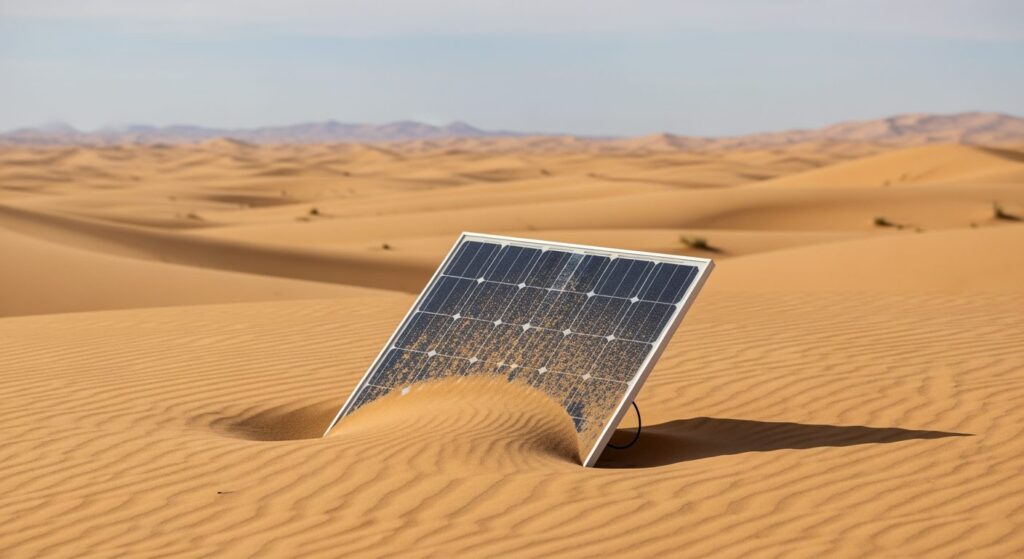
The Sahara’s extreme environment presents formidable obstacles for solar energy development. Temperatures regularly soar above 45°C (113°F), which significantly reduces the efficiency of photovoltaic panels that typically perform best around 25°C (77°F). The desert’s notorious sandstorms pose another serious challenge, as airborne particles can scratch panel surfaces, block sunlight, and require constant maintenance. Sand accumulation on panels can reduce energy output by up to 40% in just one month without cleaning. Additionally, the lack of water resources in the region makes panel cleaning particularly difficult, as most cleaning methods require substantial amounts of water – a precious commodity in desert environments.

Infrastructure and transmission challenges in Sahara solar development
Even if the environmental challenges could be overcome, the infrastructure requirements for a Sahara-based solar network present another layer of complexity. The desert lacks the necessary grid infrastructure to transport generated electricity to population centers. Building such infrastructure would require massive investment in high-voltage transmission lines spanning thousands of kilometers. Transmission losses over such distances could reach 10-15% of generated power, significantly reducing efficiency. Furthermore, the political instability in several Saharan regions creates security concerns for both construction and maintenance operations, making long-term investment risky for international developers and financial institutions.

Environmental impacts of large-scale Sahara solar installations
Large-scale solar development in the Sahara would trigger significant environmental changes that many proponents fail to consider. Recent climate modeling studies suggest that covering just 20% of the Sahara with solar panels would increase local temperatures and potentially alter regional rainfall patterns. This occurs because solar panels absorb sunlight and convert only a portion to electricity, with the rest becoming heat. The panels’ dark surfaces would also reduce the desert’s albedo (reflectivity), causing it to absorb more solar radiation than the natural sand surface. These changes could impact fragile desert ecosystems and potentially affect weather patterns across North Africa and the Mediterranean region.
| Environmental Factor | Impact of Large-Scale Solar | Potential Consequence | Mitigation Possibility | Research Status |
|---|---|---|---|---|
| Local Temperature | Increase of 1-3°C | Altered local climate | Spacing arrays | Ongoing studies |
| Rainfall Patterns | Potential increase | Ecosystem disruption | Limited options | Models vary |
| Albedo Change | Significant decrease | Regional warming | Reflective materials | Confirmed effect |
| Dust Accumulation | Reduced efficiency | Higher maintenance | New coating technology | Solutions developing |
| Biodiversity | Habitat disruption | Species displacement | Wildlife corridors | Limited research |
Political and socioeconomic factors limiting Sahara solar expansion
The geopolitical landscape across North Africa presents perhaps the most significant barrier to realizing the Sahara’s solar potential. The desert spans ten different countries, each with varying levels of political stability, regulatory frameworks, and economic priorities. Cross-border energy projects require complex international agreements that are difficult to establish and maintain over the decades-long lifespan of solar installations. Additionally, questions of energy sovereignty arise – who would control, benefit from, and maintain these resources? Many critics point to the risk of creating a new form of resource colonialism, where external powers extract energy from African territories primarily for European consumption, potentially repeating historical patterns of resource exploitation.
The socioeconomic considerations include:
- Limited local employment opportunities once construction is complete
- Potential displacement of indigenous desert communities
- Unequal distribution of economic benefits between host countries and energy consumers
- High upfront costs that developing nations cannot afford without foreign investment
- Concerns about long-term maintenance responsibilities and costs
- Risk of abandoned infrastructure if projects become economically unviable
FAQs
Q: How much of the Sahara would need solar panels to power the world?
A: About 1.2%
Q: Why don’t solar panels work well in extreme heat?
A: Decreased electrical efficiency
Q: What damages solar panels in deserts?
A: Sand and dust
Q: Who owns the Sahara Desert?
A: Ten different countries

Q: Are there successful solar projects in the Sahara?
A: Yes, but limited