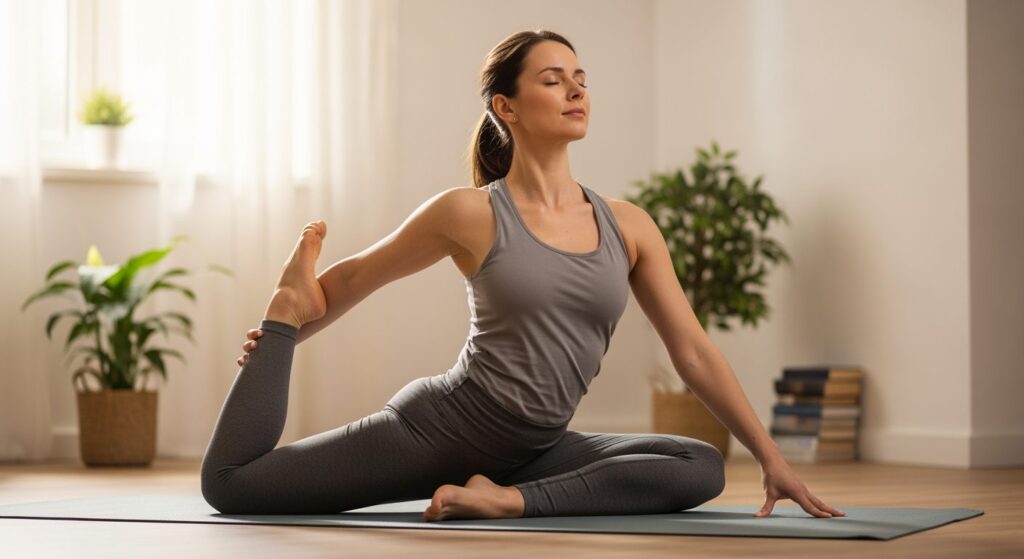
Evening Yoga for Hip Tension: If you’ve been sitting at a desk all day or just finished an intense workout, chances are your hips are feeling the strain. Tight hips don’t just cause discomfort in the pelvic region—they can trigger a chain reaction of tension throughout your lower body, affecting everything from your lower back to your knees. The good news is that a simple evening yoga routine focusing on hip-opening poses can provide immediate relief and long-term benefits. These four carefully selected poses are designed to target the major muscle groups around your hips, helping to release built-up tension and restore mobility before bedtime.
Why Evening Yoga Is Ideal for Releasing Hip Tension
Evening is the perfect time to address hip tension through yoga practice. After a full day of activity—whether that involves sitting, standing, or physical exertion—your muscles have accumulated tension that needs release. Your body temperature is naturally higher in the evening, making your muscles more pliable and receptive to stretching. Additionally, evening yoga serves as a transition between your active day and restful night, signaling to your nervous system that it’s time to downshift into relaxation mode. This mindful movement not only addresses physical hip tension but also helps release the mental stress that often manifests as physical tightness in the hip region.

The Science Behind Hip Tension and Its Effects on Your Body
Hip tension isn’t just an isolated discomfort—it’s interconnected with your entire musculoskeletal system. The hip joint is surrounded by over 20 muscles, including the powerful psoas, which connects your spine to your legs. When these muscles become tight from prolonged sitting or repetitive movements, they can pull on your lower back, creating a domino effect of misalignment. Research shows that hip tension can alter your walking gait, reduce athletic performance, and even contribute to chronic conditions like sciatica and piriformis syndrome. Regular hip-opening practices have been shown to not only improve mobility but also reduce stress hormones in the body, as the hips are known to store emotional tension.
 Plank Hold Timing Explained: How Long You Should Hold a Plank to Build Core Strength at Every Age
Four Essential Evening Yoga Poses for Hip Release
The following four yoga poses create a comprehensive routine that targets different aspects of hip tension. Each pose works on specific muscle groups around the hip complex, providing a balanced approach to releasing lower-body tension. These poses are sequenced to gradually open the hips from multiple angles, ensuring that all the major muscles—including the hip flexors, external rotators, adductors, and hamstrings—receive attention. Practice these poses in the order presented for maximum benefit, holding each for 1-3 minutes while focusing on deep, steady breathing to enhance the release of tension.
| Pose Name | Primary Target Area | Difficulty Level | Hold Time | Key Benefits |
|---|---|---|---|---|
| Reclining Pigeon Pose | External Hip Rotators | Beginner | 1-2 minutes per side | Relieves sciatic pain, opens glutes |
| Low Lunge | Hip Flexors | Beginner-Intermediate | 1-2 minutes per side | Counters sitting, relieves lower back |
| Wide-Legged Forward Fold | Inner Thighs/Adductors | Intermediate | 1-3 minutes | Releases groin tension, calms mind |
| Supported Bridge Pose | Hip Extensors | Beginner | 2-3 minutes | Counters hip flexion, opens front body |
Tips for Maximizing Your Evening Hip-Opening Yoga Practice
To get the most benefit from your evening hip-opening yoga routine, consider these essential tips that enhance both comfort and effectiveness. Creating the right environment and approach can significantly deepen your practice and amplify the tension-relieving effects. Remember that consistency is key—even a short daily practice will yield better results than occasional longer sessions. Listen to your body’s signals and adjust the intensity of each pose accordingly, finding the sweet spot between gentle stretch and productive discomfort.
- Use props like blankets and blocks to support your body and deepen stretches safely
- Practice in a warm room to increase muscle pliability and circulation
- Focus on slow, deep breathing to encourage muscle release
- Hold poses longer in the evening (1-3 minutes) than you might during daytime practice
- Pair your practice with gentle self-massage of tight areas before and after
- End your sequence with 5 minutes of relaxation in Savasana
- Maintain consistency by practicing at least 3-4 evenings per week
Incorporating these four yoga poses into your evening routine can transform how your body feels at the end of the day. The beauty of this sequence lies in its simplicity and effectiveness—you don’t need special equipment or extensive yoga experience to benefit. Many practitioners report feeling immediate relief after just one session, with the effects becoming more pronounced over time. As you continue this practice, you’ll likely notice improvements beyond just hip mobility, including better sleep quality, reduced lower back pain, and a greater sense of overall physical ease. The combination of physical stretching and mindful breathing creates a powerful antidote to the stresses and strains of modern life, particularly for those who spend long hours sitting.
The hips are often called the body’s emotional storage center in many yoga traditions, and there’s growing scientific interest in the connection between hip tension and stress response. When you release physical tension in the hips, you may also experience an emotional release—don’t be surprised if you feel a surge of emotion during or after your practice. This mind-body connection highlights why hip-opening yoga is particularly beneficial in the evening, helping to process and release the accumulated physical and emotional tensions of the day before sleep. By making these four poses part of your nightly ritual, you’re not just addressing immediate discomfort but investing in your long-term physical and emotional wellbeing.
FAQs

Q: How often should I practice these poses?
A: 3-4 times weekly
Q: Can beginners do these poses?
A: Yes, with modifications
Q: Will these poses help sciatica?
A: Often provides relief
Q: How long until I see results?
A: 2-3 weeks typically

Q: Should I warm up first?
A: Yes, briefly